Tag: Android

Smartphones and tablets now working with sensors and controllers

Introduction

A trend that we may be seeing with smartphones and similar devices is that they work with various third-party sensor or controlled devices through the use of various apps written by the sensor’s or controlled-device’s vendor. A main driver for this trend has been the “There’s an App for that” mentality that has been established around the Apple iPhone with that smartphone becoming the centrepiece of most people’s lives.

Examples of this include the recently-launched Parrot “ARDrone” remote-control helicopter that uses a dedicated Wi-Fi link to an iOS device running a special app that is its controller; a barbecue thermometer being launched at the Consumer Electronics Show 2011 that uses a Bluetooth link to an iOS device that acts as a remote temperature display. There were even other examples like the Nike running-shoe pedometer that uses a dedicated wireless link to an iPod Nano running an exercise-tracking application.

These applications may be novelty ideas of implementing an iOS or Android smartphone as a SCADA (Supervisory Control and Data Acquisition) device but there will be more applications that will become more real in our lives.

Examples application fields will include:

  • Food safety (thermometers that measure temperature for areas where perishable food is stored)
  • Personnel health and wellbeing (blood pressure and heart-rate monitors)
  • Building automation and security (dashboard apps that work with HVAC, security systems, smart meters and the like; garage door openers that work with a touchscreen smartphone)
  • Automotive and marine instrumentation (engine monitoring and diagnostics)

The current situation

The main problem is that whenever an application that works with an outbourd sensor or controlled device is developed, a lot of code is added to the program to work with the sensor or controlled device. This extra “bulk” is written by the app writer usually because the writer is the one who designs the device. The communications between these device and the host smartphone or tablet is typically using USB for wired connections; Bluetooth, dedicated or network-integrated Wi-Fi for wireless connections and the application developer has to work with the link that is appropriate to the device.

If the device designer wants to build a lively application-programming environment around the device, they have to either prepare a software development kit which usually requires the distribution of a runtime module with the application. This can take up memory and can put a strain on the battery life of the device.

What can be done

An improvement to this situation that would improve the lot for device designers and application developers who write SCADA for smartphones and tablets would be to establish a “driver” model for sensor and controlled devices.

Here, the operating system could run a “driver” for the application in a similar vein to how peripherals are managed by desktop operating systems. Here, the operating system can do things like manage the polling cycle for sensors or transmission of events to controlled devices, including responding to sensors that are set to trigger software events for the device class.

This can help with conserving battery power by disconnectiong from a sensor or controlled device if the destination apps aren’t run; or sharing data between two or more apps benefiting from the same sensor data. This could benefit some platforms, most notably Android, where one can write lightweight indicator applications like “widgets”, notification-area icons or active wallpapers which just benefit from sensor data or respond to certain conditions.

The problem is that the smartphone operating systems such as iOS and Android don’t support the same kind of programmatic modularity that desktop computing has permitted due to limitations placed on them by battery-operated handheld device designs with constrained memory and storage size. This issue may have to be examined whenever a subsequent major revision of the smartphone operating system is being worked on; and could include whether a separate “driver store” is maintained at the platform’s “app store” or that drivers are supplied as “apps”. This can then allow the manufacturers to update drivers as necessary, for example to add new functionality.

Conclusion

The idea of controlling or monitoring devices from computers or mobile devices is going to becoming something more mainstream rather than just a novelty and the operating system designers may have to factor this in to their designs.

TwonkyMobile app–another DLNA control point for your Android phone (VIDEO CONTENT)

Twonky Mobile app for your Android phone


Click on this link to view the video if it doesn’t show up on your device.

Direct link to the Twonky website

No doubt you may have decided to go towards an Android smartphone or tablet device and it may not have come with an adequate DLNA media app. There is another DLNA so

Judging from this video, I could see that the Twonky Mobile app can do what is expected of a DLNA control point app for a mobile phone or tablet device. It can even link with online content like podcasts or YouTube videos that you pull up through your Internet browsing as well as the content that is in your phone or DLNA media servers.

To get at this software, you would have to go to the Android Market and hunt for “Twonky Mobile” and is currently free for a short time.

PROMISE Technology’s contribution to the DLNA Home Media Network

News Article

PROMISE Technology Announces General Availability of SmartStor Zero and Its Fusion Stream DLNA Digital Media Apps | DMN NewsWire

From the horse’s mouth

SmartStor Fusion Stream

My comments and notes

SmartStor Fusion Stream app

The SmartStor Fusion Stream app is another program that integrates a smartphone or tablet computer based on the iOS or Android platforms in to a standards-based DLNA Home Media Network.

It is capable of what is nowadays expected for a smartphone-based DLNA network media app. That is it can play or show media held anywhere in the DLNA Home Media Network on the device itself or a DLNA Media Renderer device capable of accepting media that is “pushed” to it from a control device.

Another key feature is that it integrates the local storage with the DLNA Home Media Network. Here, you can upload pictures or videos taken with the device’s camera to a DLNA-compliant media server that supports the upload function. It can also download media held in the DLNA Home Media Network to the device’s local storage so it can be enjoyed “on the go”.

The ability to download content held on a DLNA Media Server to the local storage of an iOS or Android device with this software could be handy especially for iOS users who want to add selected pictures to their device without having to perform special sync routines. This is because iTunes doesn’t seem to support “drag-n-drop” syncing of pictures that a user selects to an iOS device – a feature that can come in handy if an iPod Touch or iPad is put in to service as an electronic photo album or digital photo frame.

A main question that I would have at the moment would be whether pictures and videos that come in to a smartphone that runs this software can be shown via a DLNA screen or uploaded to a DLNA Media Server if they came in via email, MMS picture or Bluetooth? Similarly, I would like to be sure that the program doesn’t impair the performance of the smartphone or device; or doesn’t take too long to browse the a DLNA media collection on a server.

This program could raise the bar when it comes to DLNA interface programs for mobile phones and internet tablets.

SmartStor Zero

The SmartStor Zero is another two-bay network-attached storage device which is optimised to work as a media server. As well as serving media to DLNA equipment and iTunes clients, it can accept content that is uploaded from mobile devices that are equipped with DLNA-Upload software like most of the DLNA-integration software for the Android platform and the abovementioned Fusion Stream app for the iPhone.

This device’s Web-based user interface has the ability to become an access point for the media held on the NAS. But it supports the ability to allow one to directly upload selected pictures to Facebook whether to a new album or as extra images for an existing album.

Another bonus is that the Installation software doesn’t add any drivers or other components to allow a computer to gain access to the NAS. Instead, the software works with the host operating system’s network-storage capabilities to “find” the NAS and provide a mount point or mapped drive letter for the storage resources.

One feature that I would like the DLNA software to benefit from is to support the photo tags that are part of iPhoto or Windows Live Photo Gallery. This could even include the People Tags and Geotags that Windows Live Photo Gallery supports so as to allow one to search or browse for people in the photo library using the user interface provided by a DLNA-compliant media player or control point.

What would you choose for your next touchscreen smartphone?

There are now three major touchscreen smartphone platforms that are available for the choosing – what would it be.

Hi everyone!

Your mobile phone contract’s up or you are about to consider moving from prepaid service to a regular mobile phone service. It’s now time to consider one of those new touchscreen smartphones.

Would you go for an iPhone or one of the new platforms – the Android or the Windows Phone 7? Would you also jump carrier if your desired phone platform or handset wasn’t provided by your current carrier?

Please leave a comment on this site about what you would consider choosing for your touchscreen smartphone. If you are following this site through its Facebook page, you can leave a comment on the Wall after the post.

HTC Unveils a DLNA-based ‘Media Link’ for Handset TV Streaming | eHomeUpgrade


HTC Unveils a DLNA-based ‘Media Link’ for Handset TV Streaming | eHomeUpgrade

My comments

At the moment, Samsung has already delivered a DLNA media control point / server with their Android handsets in the form of AllShare. This would have meant that someone who had an HTC Desire or wanted to start a mobile service contract using an HTC Android handset would have had to visit Android Marketplace to add on TwonkyMedia Server and Andromote to add on DLNA media-sharing / media-control functionality to their handset.

But HTC is intending to supply a “Media Link” app with their newer Android handsets to integrate them in to the DLNA Home Media Network. At the moment, this app is standard with the upcoming Desire Z and HD handsets and is intended to be available for newer HTC Android handsets.

The main issue I have with this app is whether it is available as an in-place upgrade or add-on for existing HTC Android handsets or will these users need to look towards Andromote and TwonkyMedia Server?

From what I have gleaned about this program, it seems to be able to work with content held on the handset but I would like to know whether a person can use the handset to have content held on another DLNA media server like a NAS playing on the DLNA-enabled media player or be able to “pull-down” selected content held on the DLNA media server to the phone via the network.

It is still worth keeping an eye on the Android market for apps that may do the job better than whatever comes with the phone, especially if you are after more DLNA functionality.

IFA Internationaler Funkaustellung 2010 Comments

IFA LogoI have previously published a separate article about the Internationaler Funkaustellung, celebrating the 50th edition of this show and “positioning” it as a pillar when it comes to consumer-electronics technology in Europe. In that article, I have also positioned it alongside the Consumer Electronics Show hosted in Las Vegas every January as a key consumer-technology event, especially whenever new technologies are being launched or commercialised. 

From the various press reports that I have read, it appears that the industry sees the European consumer-electronics and domestic appliance market as being very stable even through the Financial Crisis. 

Appliances

Since 2008, the IFA have been exhibiting domestic appliances and there is still the desire for energy efficient appliances that are easy to use and make less noise during use. 

Again, there hasn’t been any innovations concerning home-automation or security equipment shown at this exhibition. Nor has there been any activity concerning “backbone” heating or domestic-hot-water equipment. This may also be due to such equipment being provided by building owners rather than by householders. 

White-goods

There have been a few innovations concerning large appliances. This is mainly in the form of an automatic “as-needed” detergent dispensing mechanism for washing machines. 

But the main technology that this site is looking forward to is for Miele and Liebherr to release appliances that work tightly with the “smart grid”. The “smart grid” uses automatic meter reading and “time-of-use” pricing to encourage optimum use of electricity. It also integrates “demand-side load management” so that certain loads can be run with less power drain during peak power-usage times as well as support for “reverse metering” for client-managed power-generation installations like solar panels. 

In Miele’s case, their washing machines, tumble dryers and dishwashers can be set to commence their cycle during the time that the electricity rates are lowest. In Liebherr’s case, their refrigerator can run the freezer at a colder temperature during the time that the electricity rates are lowest so that the freezer becomes an “ice-block” thus avoiding the need to run as much during the day. 

Small-goods

This class of appliance has been mainly focused on lifestyle but there haven’t been any major innovations here. Still, the coffee machine is considered integral to most people’s lifestyle and there is still two different platforms (Nespresso and Senseo) existing for capsule-based espresso machines. 

Now this is where the real activity starts. 

Real competition to the Apple iPhone, iPad, iPod Touch and iTunes

This year, IFA 2010 has taken the shine off Apple’s face with the arrival of effective competition to the iPhone, iPod Touch, iPad and iTunes. This has mainly come in the form of Android-powered smartphones and tablet-style computers being supplied by different manufacturers. 

The event organisers even created a special show area for companies involved in the tablet-computing market to show their wares, whether through hardware, software or accessories. 

Samsung used this year’s IFA to launch the Galaxy Tab device which has an AMOLED display, Wi-Fi networking capability, 3G wireless broadband and has integrated memory capacity of 16Gb. They are also putting more effort behind the Android platform even though they have their hands in other smartphone platforms like Bada and Windows Phone 7. This is while other manufacturers like Lenovo and Toshiba presented devices for launch at a later time. Hanspree also fielded an LED-backlit LCD tablet computer which, like most of iPad’s competitors, is Android-powered. As well, ViewSonic had offered the ViewPad 100 which the first dual-boot tablet computer to run Android or Windows 7. 

As far as smartphones go, there is an increase in the number of Android-powered touchscreen smartphones even though Microsoft took Windows Phone 7 to the final “gold” stage where manufacturers can roll with phones based on that platform. But on September 5, LG had exhibited the Optimus 7 smartphone prototype which was powered by Windows Phone 7 and was demoing it working as a DLNA media control point application that was used to differentiate the phone from other handsets running the same platform. 

At the same time, the Apple iPod Touch has found a legitimate competitor in the form of the Philips GoGear Connect. This is a touchscreen-operated multifunction Internet device that runs on the Android platform. Similarly, Samsung have provided an iPod Touch competitor with their Galaxy Player 50. This device is styled similarly to their Galaxy-series Android smartphones in a similar vein to how the iPod Touch and the iPhone were styled. 

Sony has also answered iTunes as a content store by offering Qriocity as an online-content-retail platform. 

Apple tried to answer this competitive environment by staging their own product-launch event that was ran concurrent with the IFA. This is where they launched iTunes 10 which was a major revision featuring their own social network and extending the AirTunes concept which worked with AirPort Express to select AV-device manufacturers like Denon and rebranding it AirPlay. They also launched a revised iPod Touch which has many of the traits of the iPhone 4 and rolled out a major refresh of iOS 4. 

There has been a fair bit of activity in the “dedicated” e-reader market mainly from Acer, who were fielding their Lumiread e-reader and Sony who were fielding three readers. 

3D and network action in the TV market

2010 is the year of TV innovations 

2010 ist Jahr der Fernsehinnovationen 


Der Standard (Austria) described this year’s IFA 2010 as “2010 is the year of TV innovations” (“2010 ist Jahr der Fernsehinnovationen” – original German language). 

This year is also a major technological-improvement year for the main-lounge-area TV. Here, there has been a major effort in commercialising 3D TV and Internet-enabled TV. Most manufacturers are running at least one 3DTV range and running two or three TV ranges with network and Internet functionality. This is because the market is demanding 3D playback and / or online video functionality out of main-lounge-area TV sets or video peripherals. 

There is even the possibility of MSI introducing a 3D-capable laptop computer. As well,Viewsonic is to use the show to launch a 3D photo frame, camera, camcorder and portable TV as part of cashing in on the 3D craze. As well, Sony had launched a 3D home-cinema projector but would this unit need a special screen and Panasonic has also fielded a high-end camcorders capable of 3D when used with an optional attachment lens. 

At the moment, most 3D TVs and active-shutter glasses only work together if they are from the same manufacturer, but what needs to happen is for a standard communications protocol to be established so that it becomes feasible for 3D screens from one manufacturer to work with active-shutter glasses from another manufacturer. This can allow for concepts like glasses that “look the part” for the wearer or the ability to make active-shutter glasses to an optical prescription so you don’t have to wear them over your prescription glasses. 

The Internet-TV function is based upon the TVs having an Ethernet socket and, dependent on the set, 802.11n Wi-Fi wireless network functionality whether integrated or as a plug-in dongle. They will work on a manufacturer-driven platform to provide streamed or on-demand local content via the Internet infrastructure, although some manufacturers, namely Sony, are implementing Google as an Internet-TV platform. Of course, most of these sets will support DLNA media streaming from the home network if you use your home network’s NAS device to store TV shows. 

This has been augmented by the HbbTV “broadcast-broadband” hybrid TV standard being set in stone by the European standards bodies. This will also lead to Internet content and broadcast TV content being delivered to the same screen at the same time and can cater for highly-interactive viewing setups. It has also been encouraged by most of the European ISPs and telecoms carriers offering IPTV services as part of their triple-play Internet services. 

Philips have released a DLNA-capable 3D-Blu-Ray “home-theatre-in-box” system that has 5 satellite speakers and 1 subwoofer but is able reproduce a sound-field of 9.1 channels. This has been achieved through the satellite speakers being equipped with diffuse drivers to make the sound envelope the listeners.  They hava also made sure that this year’s range of 3D Blu-Ray players are DLNA capable with the BDP9600 being equipped with integrated 802.11n Wi-Fi. 

Other AV technology

Acer have achieved the slimmest desktop monitors around with their 13mm thick LED-backlit LCD units. As well, South Korea’s LG had shown the EL9500 which is a 31” OLED TV and are releasing a DLNA-ready 3DTV which uses nano-LED backlighting. 

Samsung have also continued to push out another compact digital camera which can submit photos to DLNA home networks. 

For Denon, this show marks their 100th anniversary and they were using it to launch a set of limited-edition hi-fi components. 

Telefunken have come back to the hi-fi scene with a handful of component-style systems. One of these systems, designed like the legendary Telefunken units of the 1970s, is designed to be part of the home network and also picks up Internet radio. They are also offering an Android-powered set-top box for the German market. 

Fraunhofer IIS had previewed their TA2 (Together Anywhere Together Anytime) technology. This technology allows for  HD-grade pictures and CD-grade sound for videoconferencing with H.264 video codec and AAC-ELD (Enhanced Low Delay AAC) audio codec. It could be supportive of large-screen TVs with integrated camera and microphone for videoconferencing like the recent Skype-enabled TVs that Panasonic, LG and Samsung had released. 

Conclusion

At least this year has become one of those big years that has concerned consumer technology and yielded many innovations. It has encouraged real competition against Apple when it comes to handheld computing devices and has provided a standard level playing field when it comes to Internet-assisted interactive TV.

An Android-based portable media player takes challenge at the iPod Touch

Engadget Articles

Philips GoGear Connect is a legitimate Android-based iPod touch competitor (updated) – Engadget

Philips GoGear Connect Hands-on – Engadget

My Comments

Over the last year, devices that are based on the Android operating system have challenged the Apple iPhone and iPad. Now, Philips has launched an Android-based touchscreen portable media player that can effectively compete with the Apple iPod Touch.

This unit can connect to a Wi-Fi network and download apps from the Android Market or gain access to the Web and email through the Internet. Of course, if you add Andromote on board, you can play music files from your DLNA Media Server through the GoGear or use it as a controller for your UPnP AV / DLNA Home Media Network. Similarly, you could install TwonkyServer Mobile for Android on this device and the media on there is available to the DLNA Home Media Network.

Like most Android devices, this unit supports most media codecs in use and also has other points of flexibility like a microSD card slot for extra memory or “cassette-style” media management.

The unit does have a GPS, compass and accelerometer as well as the touchscreen and trackball, which could make it become an Android-powered games machine in the same way Apple pitched the iPod Touch as an iOS-based games machine with that famous TV commercial. It does depend on what games are available at the Android Marketplace like what happens with the iPod Touch and its iTunes App Store.

If it was offered a bit more like integrated storage capacities being above that of a similarly-priced iPod Touch, this could set the cat amongst the pigeons.

The Cisco Cius business-pitched Android tablet – could this provide a platform to compete with the iPad?

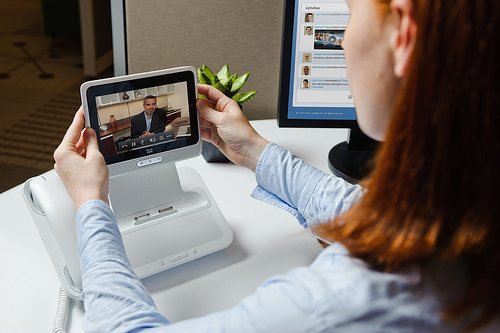
Cisco Cius in useNews Articles

Cisco Unleashes Cius iPad Killer For Business Users | SmallNetBuilder

Cisco unveils Cius Android tablet with HD video capabilities | Engadget

Cisco uncloaks Android video tablet for suits | The Register (UK)

From the horse’s mouth

Press Release

Product Page (PDF brochure)

My comments

There have been a few features that impressed me about the Cisco Cius Android tablet judging from the news articles that I have read. One was that the tablet was able to work as a fully-fledged Android tablet with access to the Android Marketplace in a manner that makes it compete with the Apple iPad. The other one was that Cisco had taken a different market – the business user – and used the Android platform to make a tablet-style computer that fits the market.

This has then allowed Cisco to develop a hardware product that can offer the necessary functionality by adding on microphones, video cameras, an interface to a speakerphone / handset dock amongst other things. They could easily take this unit further with concepts like the “next-generation home phone” or simply make a competing tablet MID based on Android under the Linksys consumer brand.

This can also lead to a Cius tablet having a longer service life beyond the business because of its ability to benefit from the Android Marketplace which could yield many consumer-focused applications like Android ports of applications like Skype or may iPhone apps.

Your Android phone now can control the UPnP AV / DLNA Home Media Network

Web site

AndroMote – An Android UPnP Remote Control

You can pick the software up at the Android MarketPlace using your Android device.

My Comments

Previously, TwonkyMedia have released a version of the TwonkyMedia Server for the Android platform but this program presents media that is held in your Android device to the UPnP AV / DLNA Home Media Network. It doesn’t offer any way for you to play media already available on the network through your Android device nor does it allow you to “push” media to another UPnP AV / DLNA device for playback or control its playback on that device.

Now another German developer have shown up with a UPnP AV control point / media player for the Android platform. This will allow you to use phones like the HTC Desire to control playback of media on UPnP MediaRenderer devices or “bring down” media available on your UPnP MediaServer to your phone for instant playback.

I had observed on the site that there is a wish for people to copy a “collection” of media like an album from the UPnP MediaServer to the Android phone’s local storage. But could this function be available for an upcoming version?

It is now becoming very real that a programmable mobile phone platform like the iPhone or the Android can be part of the UPnP AV / DLNA Home Media Network once people write software that provides media-service, media-control or media-playback functionality for the platform.

Swedish TV manufacturers implement Android in a flatscreen TV

Articles

Swedish TV Manufacture, People of Lava, Intros Worlds First Android-Powered HDTV | eHomeUpgrade

Une TV sous Android chez Lava | Le Journal du Geek (France – French language)

From the horse’s mouth

People Of Lava – Company page

Product Page

My comments

I was not surprised with the Google Android software  being implemented as an embedded-applications platform beyond the smartphone and Internet tablet. Here, “People Of Lava” have introduced a range of Internet-connected main-lounge-area television sets that use Android as their operating firmware. In fact, what’s more is that these sets are open to the Google Android Marketplace so that users can add extra functionality to them by drawing-down the appropriate apps.

What I also liked about this design was that a lot of the design costs were cut out for the manufacturer because they didn’t need to design an operating environment from the ground up when they wanted to design the equipment. It has also provided an easier path for user customisation, which may be of benefit with Internet-based TV services like IPTV and catch-up TV; and sets deployed in hotels and similar businesses.

This has then proven that the Google Android platform can become a serious contender for the embedded and dedicated-purpose operating system marketplace.