Filed under UPnP AV / DLNA media server software by simonmackay on 01/07/2010 at 00:43
no comments
News article
Stream Audio Outputted by Your PC to Any DLNA/UPnP Compliant Device via Jamcast | eHomeUpgrade
Direct Link
Jamcast’s Web site: http://www.sdstechnologies.com/
Support Forums: http://www.sdstechnologies.com/Forum/
My comments
Previously, there have been some computer sound-reproduction setups which comprise a special “virtual-soundcard” program that is running on a computer and transmitting the data via a local-area network to a “network audio adaptor” connected to a sound system. The solutions, which came in the form of the Linksys WMB54G Wireless-G Music Bridge (Wi-Fi 802.11g solution) and the Devolo dLAN Audio Extender (HomePlug solution), capitalised on the idea of moving your computer’s sound to better speakers hooked up to a better amplifier that is part of your main music system. But these all required their own particular driver software for them to work properly.
Now Jamcast have come up with a UPnP AV / DLNA Media Server program that runs on the Windows platform which works in the same vein as these previous devices. But it has another trick up its sleeve beyond just being a regular media server. It can work with the UPnP AV / DLNA compatible media playback device as a “virtual soundcard” like these other devices that I had mentioned previously.
If you used a Windows XP box, you would have to set the device to work with a virtual “stereo mix” recording channel on a compliant soundcard so that all of the PC sound is handled by this software but a Windows Vista or 7 box can handle these setups better because of inherent support for an integrated “stereo mix” recording channel.
There may be some caveats with this kind of setup at the moment such as latency issues concerning game sounds or the ability to provide a discrete surround-sound feed to a surround-capable receiver. From what I hear of the discussion boards at Jamcast’s site, there were issues with “forcing” MP3 output to particular DLNA devices so that they pick up a recognised codec rather than FLAC. Another questions is whether you can have the virtual soundcard being fed wit the same audio stream as the computer’s local sound subsystem and if there is any latency issues with this setup.
Another idea that could be looked at as far as further development work goes would be to port the software over to the Apple Macintosh platform in order to open up that platform to more UPnP AV / DLNA server solutions.
This may yield further applications like use of audio content on a laptop via a sound system that is connected to a DLNA audio device to use with audio services that only work with PC-based software. A good idea for Jamcast to explore would be a “slimmed-down” version of this virtual-soundcard software that can be licensed out to other software developers to make use of DLNA devices as a “virtual sound card”. An example that could come in to its own are the party-hire jukeboxes like the SuperJuke that people hire for major birthday parties and similar events. Here, the music feed from these machines could be fed to DLNA-enabled endpoints on a home network as well as the machine’s local speakers.
What I am pleased about with this is that the UPnP AV / DLNA standards are being taken further to build more innovative hardware and software for the home or small-business network.
Filed under UPnP AV / DLNA media controller hardware, UPnP AV / DLNA media-playback hardware) by simonmackay on 28/06/2010 at 15:07
no comments
Article
D-Link’s Xteme N DIR-685 All-In-One Router Gets DLNA Certification and Some Nifty New Features | eHomeUpgrade
Download link:
D-Link’s support website – DIR-685 downloads
My comments
I had previously mentioned the D-Link DIR-685 Wireless-N Broadband Router / Electronic Picture Frame in this site during my coverage of the CES 2009 show in January 2009. This warranted my attention because of a storage router that also worked as an electronic picture frame because of its colour LCD display.
This router also was part of the DLNA Media Network because it could become a DLNA media server for material held on a user-installed hard disk or an external USB-based storage device. But this functionality has been extended through the latest firmware update for it to become a control point in the DLNA Media Network as well as showing pictures held on other DLNA Media Servers on that same network.
By the same token, the screen can be controlled by other DLNA Media control points such as TwonkyManager or a control point integrated in a smartphone like Andromote (Android), PlugPlayer (iOS – iPhone / iPad / iPod Touch) or the one that part of most of the Nokia phones.
At the moment, the utility of this function is limited to digital images because there isn’t any sound-handling functionality in this router.
This could lead to ideas like a “two-box two-screen” network solution for visual merchandising consisting of this router and a Sony or Samsung DLNA-ready TV with images shown on both the router and the TV. Similarly, this device could be seen as another “screen” for pictures to appear in another area but sharing a common pool of pictures in the network.
Therefore this is another example of a common standard breeding product software innovation rather than an imitative design culture.
Filed under Smartphones, UPnP AV / DLNA client software by simonmackay on 25/05/2010 at 17:55
one comment
Web site
AndroMote – An Android UPnP Remote Control
You can pick the software up at the Android MarketPlace using your Android device.
My Comments
Previously, TwonkyMedia have released a version of the TwonkyMedia Server for the Android platform but this program presents media that is held in your Android device to the UPnP AV / DLNA Home Media Network. It doesn’t offer any way for you to play media already available on the network through your Android device nor does it allow you to “push” media to another UPnP AV / DLNA device for playback or control its playback on that device.
Now another German developer have shown up with a UPnP AV control point / media player for the Android platform. This will allow you to use phones like the HTC Desire to control playback of media on UPnP MediaRenderer devices or “bring down” media available on your UPnP MediaServer to your phone for instant playback.
I had observed on the site that there is a wish for people to copy a “collection” of media like an album from the UPnP MediaServer to the Android phone’s local storage. But could this function be available for an upcoming version?
It is now becoming very real that a programmable mobile phone platform like the iPhone or the Android can be part of the UPnP AV / DLNA Home Media Network once people write software that provides media-service, media-control or media-playback functionality for the platform.
Filed under Product Review, UPnP AV / DLNA media-playback hardware) by simonmackay on 17/05/2010 at 13:43
no comments
I am reviewing the Sony STR-DA5500ES high-end home theatre receiver which is the first network-capable home-theatre receiver that I have reviewed in my blog. At the moment, Sony have supplied me with the SRS-DB500 2.1 powered speaker set which I will be reviewing in a separate article on this blog, for use with this receiver.
Some of you who may not understand sophisticated audio setups will benefit from a reference page which will explain the terms that I will use when describing this receiver and other audio equipment in this blog.
This unit is the second model down from the top-of-the-line STR-DA6400ES receiver in Sony’s high-end “ES” range of home-theatre receivers but is still very capable in its home-theatre-hub role.
Fit and finish
This receiver has the same fit and finish associated with the good-quality Sony hi-fi equipment that has existed for many years/ The controls are smooth and properly responsive and the unit’s finish looks “very polished”.
Usability
This unit excels on useability in a similar manner to most Sony home AV equipment that I have used.It has that very bright vacuum-fluorescent display that is easy to read even at dim levels and the controls are easy to manage.
Normally comes with two remotes – one with many buttons for controlling a home-theatre system’s components and for full control of the receiver; one for GUI-based control of the receiver.
Connectivity and Flexibility
This high-end receiver excels in this field of connectivity and flexibility. There are seven 120W power amplifiers built in to this unit’s chassis. You can set up a 7.1-channel speaker setup so you can properly enjoy movie content on Blu-Ray discs that is mixed to a Dolby Digital EX 7.1-channel sound-mix. On the other hand, you can set up a 5.1-channel speaker setup for Dolby Digital 5.1-channel sound-mixes commonly on digital TV or DVD and use the two spare power amplifiers for different setups.
Firstly, you could have speakers in another room to play another stereo sound source to that room or set up a sophisticated “bi-amp” setup where the tweeters and woofers in a capably-wired pair of front speakers are amplified separately. The limitation with this receiver is that there isn’t the ability to have the crossover functionality or the amplifier levels managed in a bi-amped setup.

An example of very good connectivity options
The multi-zone feature also allows for yet another zone to be catered fro as an audio-only stereo zone but with its own amplifier. Similarly, the secondary zone can be amplified with another amplifier. The line outputs for the extra zones are in fact line-level outputs that are independent of the main volume control and you would have to adjust the sound at the remote amplifiers.
These setups also allow you to “scale up” your sound system as you see fit and can afford the extra equipment. You can even start with a pair of good stereo speakers and, as you can afford them, connect up extra speakers for your surround-sound setup.
There are plenty of audio and video inputs for extra audio and video equipment, Music enthusiasts are even catered for with a phono input for a good turntable as well as two tape loops for recording devices like cassette or MiniDisc decks. These same connections can be used for connecting up a computer’s sound subsystem for recording vinyl or cassettes to the hard disk rather than using those poor-quality USB turntables. Those music enthusiasts who believe that the audio reproduction of a dedicated CD player connected to the analogue inputs is better than that of a DVD or Blu-Ray player connected to the HDMI or optical digital inputs of this receiver can connect the CD player to these inputs.
The front panel provides walk-up connections for 1 regular video source (composite video, stereo analogue audio and optical digital audio) and 1 HDMI video source.
There is a DMPORT connection for use with optional Sony-supplied modules that provide connection to and control of various portable devices. These include Sony Walkman MP3 players, phones that have Bluetooth A2DP functionality like my Nokia N85 as well as Apple iPods and iPhones..
For video displays, there is connection for two HDMI-equipped video display devices so you can run a projector or smaller “operator-console” LCD screen alongside the regular large-screen LCD or plasma display. The receiver also supports video-signal conversion from regular video signals to HDMI signals, which means no need to connect composite or component cables to the main display to gain benefit from legacy video sources.
Network AV
The receiver offers some network-enabled functionality but this is limited to playback of DLNA media content with the user controlling the receiver through its remote control and requiring the video display attached to any of the monitor outputs being on to select toe content. For radio functionality, the unit can only work with Rhapsody or Shoutcast Internet radio services.
This network connectivity is made feasible by the receiver having an Ethernet connection. This means that it can work also with HomePlug AV powerline networks when you use a HomePlug AV-Ethernet bridge; and is my preferred “no-new-wires” network-connection method for connecting home-theatre and hi-fi equipment to a home network.
When you navigate a DLNA media server, you have to choose the kind of content you are after – music, pictures or video. If you browse around the same server for content outside the class you selected, this receiver will not start any of that content.
It could be feasible to select audio content by using the receiver’s built-in display and through the use of either the remote control or controls on the unit’s front panel. For Internet-radio functionality, it could be feasible to select Internet-radio content from vTuner, RadioTime or Reciva directories which include access to local radio from other countries.
Sound quality
The sound quality is as you would expect for high-end Sony gear, where it is not coloured. I even noticed this with my computer’s sound which was fed through the SACD/CD input and out through the Preamp outputs to the SRS-DB500 speaker set. I switched the unit in to regular 2-channel mode, then to “analogue direct” to assess whether the digital circuitry was colouring the sound. The receiver and the active speakers were set to “tone-flat” – bass and treble at centre positions in order to really assess how it sounded and I had played one of the early “Café Del Mar” recordings from my PC.
The reason I use this kind of recording is to assess the equipment from a mature user’s viewpoint and find out how it handles music other than aggressively-amplified pop music. In the context of the home theatre, it would also include being able to yield the whole soundtrack of a movie or TV series.
I haven’t been able to test the receiver with regular passive speakers but the power amplifiers are something worth trying out and using.
Limitations and Points of Improvement
I had mentioned that there could be some points of improvement as far as network operation goes. These include the ability to use the unit’s display and controls to select and control audio material from DLNA servers on the home network, without the need to switch on the TV display. Similarly, the receiver could offer what competing home-theatre receivers offer where you can “tune in to” Internet-radio stations offered by vTuner, Reciva or RadioTime directories.
For operation, a main point of improvement would be to allocate one video monitor as a “control monitor” while the other monitor shows video content. Here, it could allow for a smaller screen to be used for this purpose while the larger screen is used for the primary video.
Conclusion and Placement notes
Save for certain network-media limitations, this receiver would be considered as a worthy candidate for a primary “hub unit” for the main home-theatre area. It is also well-placed for audio enthusiasts or people who have material on legacy formats like vinyl records and want to be able to play these material on good equipment.
Notes:
The cited output power is based on manufacturers’ specifications with an 8-ohm speaker load and 0.09% total harmonic distortion (minimum quoted in the specifications).
Filed under Product Review, UPnP AV / DLNA media-server hardware by simonmackay on 11/05/2010 at 14:40
no comments
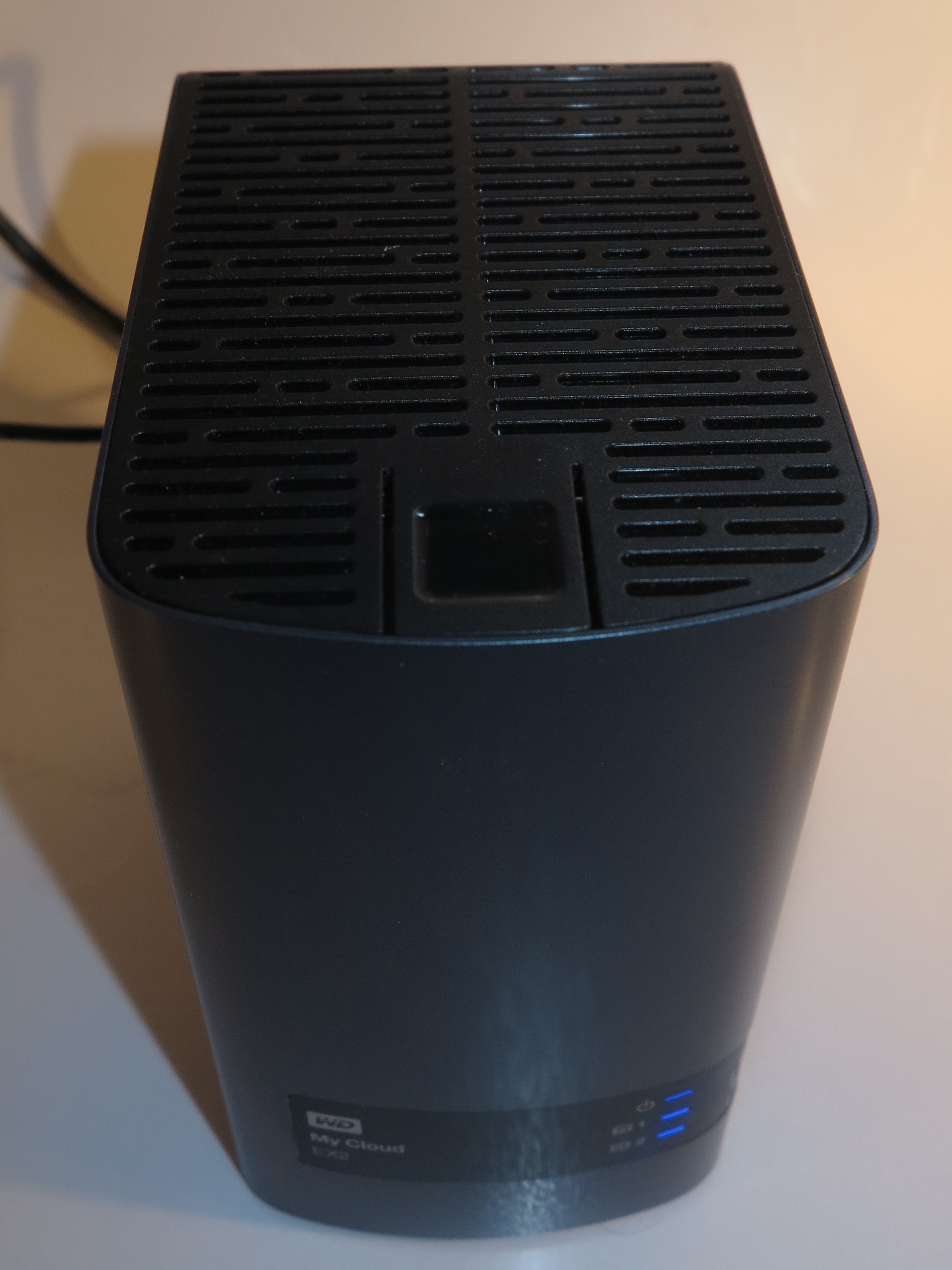
I am now reviewing the Western Digital MyBook World network-attached storage device which is the first such device to be reviewed in this blog.
It is a white box about the size of an average paperback book such as a personal Bible but has a white “operation” light along the spine. This light can be turned off through the Web-based configuration menus under the “System-Advanced” screen in the Advanced menus. There is a vent along the top of the unit to allow for proper cooling.
Connection
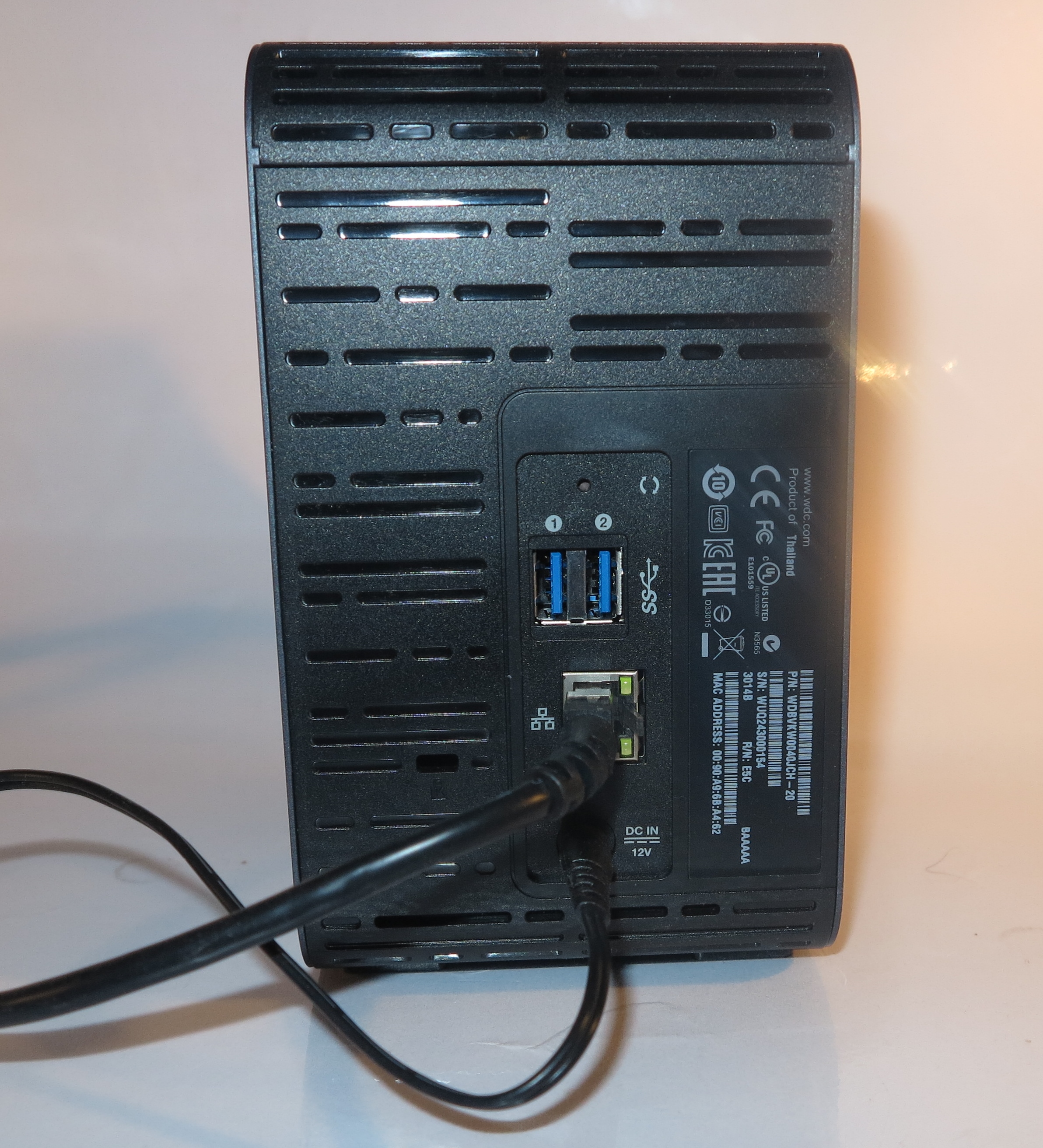
It can connect to an Ethernet network, even a Gigabit one which would be part of high-end routers and equipment optimised for “next-generation” broadband services. There is also a USB socket for use with adding external USB storage or USB printers that can work as network printers to the network.
Storage
This unit has 1 Terabyte worth of storage available on it, which would be the minimum required for these devices. If you use it primarily as a media server, you would have plenty of room for many hours of high-definition video, oodles of “many-megapixel” pictures and many hours of audio content using good-quality codecs.
This is provisioned through one hard disk but the step-up model (WD MyBook World Edition II) has the ability to work with two user-replaceable hard disks and can support a two-disk RAID data-mirror setup.

Ethernet connection to the WD NAS
Network functionality
It may be worth noting that I have run this unit on the latest firmware and is a wise practice to do whenever you buy these units to make sure they run the latest firmware.
It can work with the common network file protocols like FTP and SMB, but the Samba (SMB) server can’t handle credentials situations where you have the same username and password as one of the computers. As well, it isn’t easy to create a NAS share with a “public read-only” access condition where you have to log in to add or modify files on that share but anyone can read the files.
There is support for “cloud backup” and “cloud remote access” with WD’s MioNet cloud-based remote servers, but I haven’t tried this feature out yet.
The main function that I have appreciated in this NAS is the TwonkyMedia UPnP AV MediaServer function. This positions the NAS as a very capable network media library that provisions the media to standards-based media devices. It can also work as an external media drive for iTunes-based media setups.
This has allowed for PC-free media serving where I could play “ripped” audio files on any of the Internet radios that I have reviewed without needing to have the computer on. As well, it has improved the reliability of my UPnP-based media experience because the network hard disk is doing just that job of providing the media rather than a PC that does this amongst other activities. The UPnP functionality could be better supported by working with other shares that can be set up as “public read-only”, rather than just the “Public” share. It would then increase its validity as a media server in businesses where media collections are at risk of unauthorised alteration.
Points of Improvement
As I have outlined in the review, I would like to make it easier to provide “public read-only” shares which are able to be edited by authorised users but the files can be viewed by anyone without authentication and media files can simply be provided for playback by UPnP devices. This can make it easier to share media or other files across the network without fear of accidental or malicious alteration or deletion.
There could be some finer control on the status LED by providing for a static “bar-graph” display that indicates how much disk space has been used, or light-up only as a “distress signal” or if the hard disk is in active service. This is so you can know what is going on without that bright light staying on all the time.
Summary and Placement Notes
I would suggest using this hard disk as a “simple network backup” device or as a dedicated UPnP media server device for the home or small-business network. In the latter usage case, these businesses could easily relegate this unit as a secondary “media-server” NAS alongside their primary NAS that provides regular network file-service functions and establish UPnP AV / DLNA in their realms as I have talked about in a separate article.
Filed under IP-based broadcasting, Product Review by simonmackay on 10/05/2010 at 16:20
no comments
I am reviewing another of the Internet radios that are in that “mantel-radio” form factor like the Kogan Internet radio that I previously reviewed. From what I have noticed, it was as though it was the Kogan radio but without an iPod dock and in a glossy white cabinet.
The set is connected to mains power via a mains cord that is attached to the set rather than the usual AC adaptor that plugs in to the set. This is more in line with the traditional mantel radio or most of the clock radios that are currently ins use and will be likely to benefit people who have to deal with crowded power outlets and powerboards,
The set uses a bitmap LCD display which yields a large clock display whenever it is turned off and provides a useable menu display. The knobs are of an equal shape and all the buttons are lined up under the display in a single row. This may impair useability for older people because the labelling is too small.
On the other hand, the volume control is a real analogue volume control rather than the rotary encoder that I have used on most Internet radios and other recent consumer electronics. This will appeal more to mature people who want greater control of the set’s output volume – I have even heard that a sign of a person’s maturity is knowing that the volume control can be turned down rather than always up!!!!
Connectivity

Kogan and OXX Internet radios alongside each other
Like the Kogan table radio, there is an auxiliary input for external audio equipment like MP3 players and Discmans as well as a headphone jack which you can use as an external speaker jack when connected to active speakers.
It also excels on network connectivity through the provision of an Ethernet socket for use with wired networks, including HomePlug powerline networks. The wireless-network connectivity has been improved through support for WPS “push-push” setups as well as network profiles for multiple different wireless networks.
Use
There are four preset buttons for each of the operating bands as well as support for integration with the “www.wifiradio-frontier.com” Internet-radio portal. This then allows for a larger list of preferred stations to be kept consistent across multiple sets.
The unit also has improvements in other areas like dead-programme “clean-up” with DAB multiplexes for sets that are moved between towns or whenever the multiplexes are rearranged. Similarly there is also an equaliser function with fiver tone presets and manual adjustment for bass and treble. There wasn’t a loudness-compensation control on the manual tone adjustment unlike other Frontier radios with similar firmware.
It does work well with DLNA media services, especially the TwonkyMedia Server that is part of the Western Digital MyBook World Edition network hard disk. At the moment, it only works as a media player that can be operated from its control surface.

Bitmap display on OXX radio
When this set is run at a loud volume, it sounds as loud as the Kogan set, which is loud enough to cut over noisy kitchen appliances for example.
Limitations and Points of Improvement
One main limitation that I have experienced is the tendency to work on a small buffer which causes the radio to “start and stop” especially when playing some overseas Internet radio stations. It may be also limited through problems with Wi-Fi networks that may be difficult in some areas. The problem may also become worse as more people “hit on to” Internet radio – the new “short-wave” band, and servers don’t work well for quality of service. Other radios don’t seem to be as sensitive to this problem as much as this model.
A point of improvement that I would like to see would be steps to make the set more ergonomic and easier to use. For example, I would like to make the buttons more prominent so they are easier to find. This is more so for the on-off button and the mode button. As well, the LCD display could be better replaced with one of the monochrome OLED displays to improve on readability, or could be engineered to fill the display panel space more to make better use of that space.
Other than that, there wasn’t any other main limitation with this particular set for its class.
Conclusion
Although there is the limitation with the set working on a small buffer and being more prone to “start-stop” behaviour with Internet radio, it can work well as a tabletop radio / network media player for an office, waiting room, small shop or kitchen. I wouldn’t recommend this set for use in a workshop or similar location because of the glossy finish being more susceptible to damage that occurs in those areas.
Filed under UPnP AV / DLNA by simonmackay on 07/05/2010 at 17:17
no comments
News article – from the horse’s mouth
Mobile Handset Manufacturers Attain DLNA Certified® Status – DLNA
My comments
From this press release, I had noticed that the mobile-handset brands that have been considered of high value had also added DLNA, whether as a control point, media player / renderer or media server, to their feature lineup. This will mean that they will work with a DLNA-based home media network in a proper way, whether to play music or exhibit photos and videos existing on the phone on home AV equipment or become remote controls for home AV equipment.
These companies have also moved towards other standards-based activities like adopting OMTP standards such as use of a microUSB connector for power and data as well as a 3.5mm four-conductor jack for wired headsets. Most of these phones also operate their Bluetooth functionality in a purely standards-based way that will work, such as proper “object push” between phones. The different phones may work to a Symbian S60 or UIQ operating system, or the Android operation system or an inhouse operating system like Bada, but they work with other devices on a level playing field.
Compare this with Apple where the iPhone, considered to be the “coolest phone in town”, doesn’t work with other phones or peripherals unless you pay big money for “apps” or Apple-approved peripherals; or work out various “kludges” to achieve compatibility.
It will be interesting to see whether the smartphone market moves towards standards-based compatibility (use of OMTP standards like microUSB, proper Bluetooth behaviour, DLNA) or stay with what looks “cool” and move towards an ecosystem defined by Apple.
For me, I would certainly stick towards standards-based operation like DLNA if I was choosing a smartphone when I have an opportunity to upgrade my phone.
Filed under UPnP AV / DLNA media-playback hardware) by simonmackay on 26/04/2010 at 15:40
no comments
Product Page
AVM FritzWLAN Repeater NG – manufacturer’s page (German language)
My comments
This gadget had intrigued me not just because it was a WDS-compliant Wi-Fi network repeater for all of the Wi-Fi networks but was a DLNA-compliant media player without a control surface.
It plugs in to an AC outlet in a similar manner to a HomePlug wireless access point like a Netcomm NP290W, Solwise ‘85PEW or Devolo dLAN Wireless unit. But this connection only exists to power the unit and, at the moment, is available only to fit the Continental-European power outlet.
The main strength in my opinion is its prowess as a network music player for the DLNA Home Media Network. It can be controlled by Windows Media Player 12, recent Nokia phones, TwonkyMedia Manager, an iPhone running PlugPlayer; and other UPnP AV Control Points or through its Web user interface. That same Web user interface can be used to select between six different Internet-radio streams of your choice but you would have to know the URLs of these streams.
You can connect it directly to a music system via its line input or digital input or enable a built-in “flea-power” FM transmitter to have it play through an FM radio tuned to a frequency that you nominate through the Web interface.
The closest competition to this device would be the Apple Airport Express which works as a USB print server, wireless-only router or network music player that only works with iTunes.
What I would like to see for this device would be to have it able to work beyond Continental Europe i.e. available with plugs to suit North America, UK, Australia and other markets. If extra value were to be applied to this device. It could also be improved with HomePlug AV and Ethernet connectivity in a similar manner to the aforementioned HomePlug wireless access points and work properly in an extended service set with client roaming to latest specifications.
The Internet-radio functionality could be improved by having the FritzWLAN Repeater work with an established Internet-radio directory like vTuner, Reciva or RadioTime to select the radio streams. This could then be taken further with access to the user favourites functions that the directories have.
The main take from this is that AVM have pushed the boundaries by adding a standards-based media player to a Wi-Fi network repeater instead of following the crowd.
Filed under Product Review, UPnP AV / DLNA media-playback hardware) by simonmackay on 08/03/2010 at 14:43
no comments
I am reviewing one of Revo’s latest Internet radios – the Domino FM/DAB+/Internet table radio which one of many of the radios appearing in this class.
This set comes in a charcoal-grey rubber-textured housing, with a joystick on the front as the main selection control. It also has a knob for selecting between operation modes and another knob to turn the volume up and down. As well, you turn the radio on and off by pressing this knob in a similar manner to most car radios.
The display is in the left “porthole” on the front of the set and is a small OLED display with a similar “off-white” colour to the vacuum-fluorescent displays on most consumer electronics made by Sony and Panasonic.
There is an integrated iPod dock that is covered by a removable panel and the set came with Apple-style iPod inserts that work with whichever iPod or iPhone you have.
It also comes with a card-style remote control which, like its stablemate, allows for operation from a distance and allows for direct access to the locally-preset stations.
Setup
This process is similar to most Frontier-platform Internet radios like the Kogan and the Revo iBlik. The set is capable of supporting “quick-setup” with WPS “push-button-setup” routers and is the first one that I have reviewed to offer this method/ But this option isn’t made as part of the Network Setup Wizard, rather you have to go to System Settings – Network menu and select “PBC setup” to instigate this kind of setup.
It is also the first Internet radio that I have reviewed that supports multiple wireless-network profiles (SSID and security-parameter combinations). Here, this set can remember the profiles for the four last-used wireless networks but the user can delete a particular network profile from the list.
Operation
It works in a manner similar to the other Internet radios that I have tried, with a “mode selector” and heavy use of menus. The unit also supports FM radio with RDS and DAB/DAB+ digital radio for regular RF-based radio service. The aerial for this is a telescopic rod one that is clipped vertically on the back of the unit so you don’t have to unclip it when you just need to extend it upwards.
The set stores 10 preset stations for each “band” – FM, DAB and Internet radio; and you select them by pressing the star button and highlighting the station with the joystick then pressing the joystick to hear it. To set a station as a preset, you press the star button to show preset list, then hold joystick button in until “Preset saved” comes up on display. For Internet radio, this is in addition to the favourite stations that you have identified at the wifiradio-frontier.com Website.
The set works properly with a UPnP AV / DLNA home media network and the transport controls on top of the set allow you to move across the music collection that you are playing.
The set can work as a replacement for the old clock radio in the bedroom. The Alarm button on the front of the set is for enabling different previously-set alarm times when the set is off or to set the alarm times when the set is on. You can set two different alarm times and determine what to wake to – buzzer, FM station, DAB station, Internet station or iPod for each alarm time. Like the iBlik that I reviewed previously, you can set an alarm event to occur on a particular date, every day, every weekday or every weekend. When the alarm sounds. all the buttons on the unit reset the alarm. The joystick works as “snooze button” and repeated pressing of it allows you to extend the snooze time. There is a sleep-off timer that causes the set to stop playing after a known time. but you have to go through the menus to start the sleep timer, something you wouldn’t do if you are very tired and just want to drift off to music.
There is inherent support for the last.fm “personal-music” service which can “learn” your music tastes from music played from your iPod, last.fm’s Internet radio service or a UPnP AV media server.
Sound quality
The Revo Domino is the first Internet radio that I have reviewed to have tone controls. These are found under “Equaliser” option in “System Settings” menu. There are 5 preset tone settings plus a user-determined tone setup – bass, treble and loudness-compensation.
The NXT “dual-radiator” speaker allows for some “punch” in the sound without suffocating the vocals when music is played. It also reproduces speech very clearly and the set can put up a significantly loud volume without distorting. This can be of benefit if you need to use it in noisy environments.
This unit has the similar output level to most radios of its kind, enough to fill a reasonably-size room with easily–identifiable music and can compete with the noise emitted by typical kitchen appliances.
Points for improvement
There are a few places where the Revo Domino could be improved.
One is that the OLED display could be made a bit larger. This could improve its useability, especially if the user doesn’t have good eyesight, which may be common with senior citizens.
It also could benefit from having a headphone jack installed, which can cater for late-night listening or for playing it through an active speaker system.
Conclusion and placement notes
Beyond the above-mentioned limitations associated with a small display and the lack of a headphone jack, there isn’t anything much else that I could fault this set on.
Here, I would recommend that the Revo Domino be best sold as a “step-up” Internet radio / iPod-dock combination for use in the kitchen, office, workshop, or small shop. It can also work well as a clock radio even though you have to go in to the Main Menu to set the alarm or enable the sleep timer.
Filed under Future Trends, IP-based broadcasting by simonmackay on 12/02/2010 at 12:46
no comments
TiVo, Sony and others to FCC: ‘gateways’ should replace CableCARD — Engadget HD
My comments on this idea
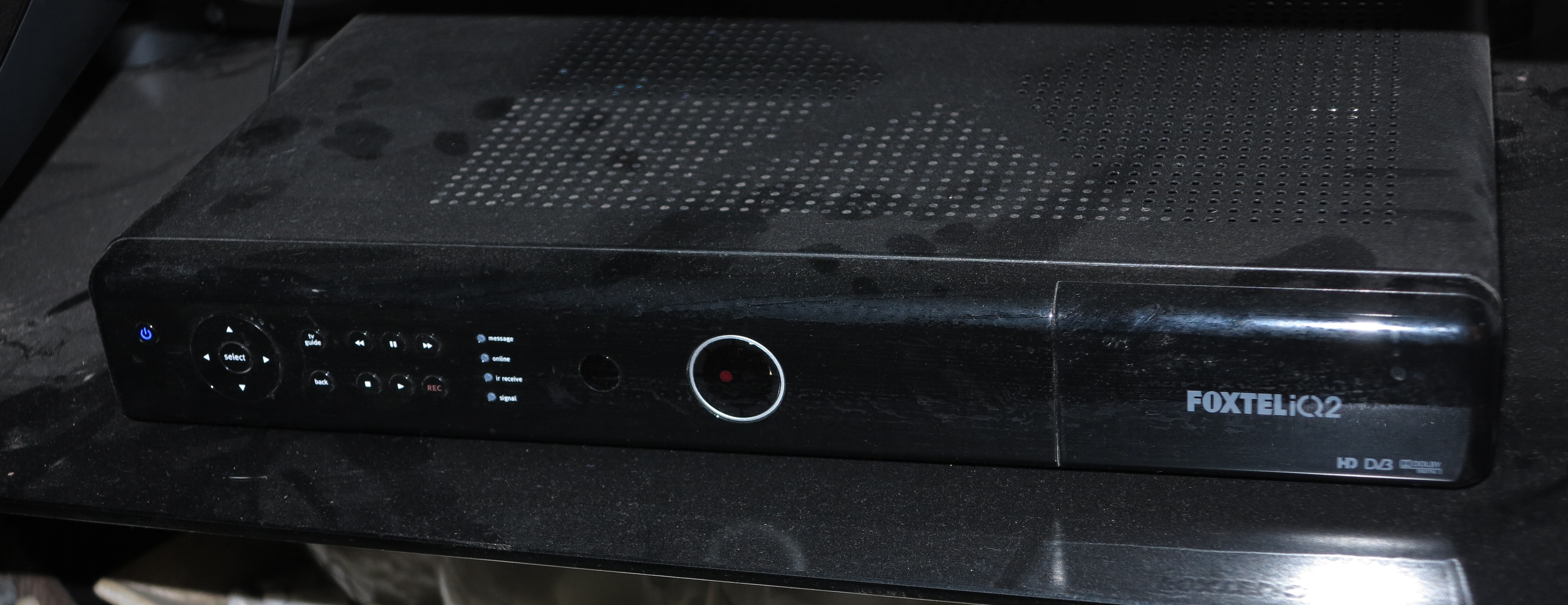
The common situation with most TV households is that if they sign up to a pay-TV service like Foxtel (Australia), a local cable-TV franchise in the USA, DirecTV (USA) or Sky TV (UK), they can only watch TV through the set-top box provided by the service provider. The TV remote control ends up becoming redundant as they have to use the set-top box’s remote control for their TV viewing.
If they want to use a DVR i.e.. a “personal TV service”, they have to use the DVR option provided by the pay-TV provider rather than get a retail DVR solution like TiVo, a home-theatre PC such as Windows Media Center or one offered by a major consumer-electronics brand. In some situations like some cable-TV implementations in the US, you may be able to use a retail DVR solution along with a special “CableCARD” and, perhaps, a “tuning adaptor”. But this doesn’t provide the full service that the customer has put money up for, such as interactive TV or access to “pay-per-view” or “on-demand” content.
As well, a lot of these providers often charge an extra fee if the user wants to deploy a set-top box in other rooms. This typically means that one TV set, usually the one installed in the main lounge room or family room, is subscribed to the pay-TV service. At best, most users may deploy the second set-top box in a secondary lounge area like the rumpus / games room.
What is the layout preferred by TiVo, Sony and others?
The layout would consist of the following:
- A “gateway device” or broadcast-network tuner connected to the cable service or satellite dish which “tunes” the pay-TV services and manages access to these services. It then makes them available over the home network using IP-based standards and technologies. This device can also pass back information relating to “pay-per-view” content orders or interactive television from the endpoint devices. It can also handle on-demand content offered by pay-TV providers in the convention context and fulfil the content to the desired end-devices.
- Standards-compliant endpoint devices (TV sets, DVRs, etc) that are connected to the home network and discover the services and content using technologies like DLNA. These devices can work with interactive services provided by the TV service provider and provide the viewer’s responses to the gateway device via the home network.
This is similar to the “broadcast-network tuner” setups like Devolo’s dLAN Sat, the Tivit ATSC mobile DTV WiFi tuner and the HD HomeRun tuner, where there is a digital-broadcast tuner that passes the signal via an IP-based home network to a hardware set-top box or software player program in a general-purpose computer so people can view the TV programme. These solutions typically used a non-standard control method and, in most cases, a single RF front-end so that only one TV set could operate at a time and they couldn’t work with a DVR or similar device.
Why develop this layout?
There is a desire for true competition in the multichannel pay-TV industry concerning end-user devices that is similar to what has occurred with telephone hardware since the Carterfone Decision in the USA and the Davidson Inquiry in Australia. One of the goals is to provide a TV navigation interface that encompasses off-air, pay-TV and IP-delivered content in the one electronic programme guide. This guide’s interface would be “skinned” to match the host device’s branding or any user customisations that are available to the device’s user. It also means that the user only needs to deal with one remote control to find whatever they want to watch.
This kind of layout could allow each TV set and each computer in the house to have access to all of the pay-TV services, rather than the common situation of having to deploy pay-TV set-top boxes to each place where there is a TV set.
There is the ability to upgrade the gateway to suit changing technological needs such as change of infrastructure or improvement in transmission or security protocols. That same ability also exists if the user wants to change providers or sign up to a supplementary-content service. Here, in all the situations above, there is no need to replace the end-user’s devices like DVRs or Internet-enabled TV sets, nor is there a need to replace software on any of the computers in the house to accommodate these changes.. In these cases, the software or firmware can discover the new services that are provided through the new hardware.
What needs to happen
One thing that needs to happen is high-profile implementation of common standard technologies like UPnP AV in the broadcast-reception sphere. This includes having endpoint and recording devices work to these standards when discovering and receiving broadcast signals via an IP network. It also includes the recognition of electronic-programme-guide data provided by these gateway devices, especially if the device that benefits from the data is a recording device like a “personal TV service”. It doesn’t matter whether the client device has the programme-guide data or the broadcast-network tuner has that data. This also includes handling situations where the same broadcast service can be received through different paths such as one or more over-the-air channels and / or a cable or satellite service.
In a similar light, broadband routers that work as the network-Internet “edge” could work as a “gateway” for IPTV services by storing channel lineups and service-authority information for these services. This device may also have to support handling of interactive-TV sessions in situations where the endpoint device cannot handle the sessions itself.
As well, interactive-TV setups would need to work with an IP backhaul irrespective of whether the TV signal is delivered via RF (cable, classic-TV-aerial or satellite) means or via an IP feed. This also includes allowing access to downloaded assets associated with interactive content.
Conclusion
As mentioned before, what needs to happen is the use of common standards and device classes to support broadcast-network tuners; standard viewing and recording devices; and the home network in order to democratise the provision of pay-TV services.